
US&R Medical Team Specialist – Instructor Lead Training MTS0426 (April 22 – 25, 2026)
Description:
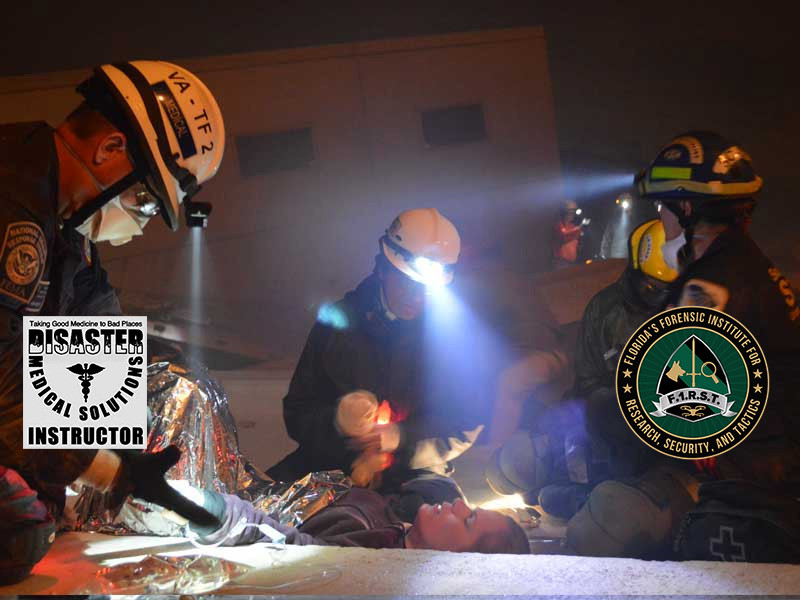
The National Urban Search & Rescue Medical Team Specialist (MTS) Course is being held at Florida’s Forensic Institute for Research Security and Tactics (F1RST) in Land O’ Lakes, FL. This equivalent course delivery is strictly structured under FEMA US&R standards guidelines and curriculum. The course is designed to fulfill initial training requirements for Urban Search and Rescue Task Force Medical Specialist (paramedics) and Medical Team Managers (physicians). Team deployment, medical operations, health/safety, confined space medical and rescue techniques are addressed.
Disaster Medical Solutions – Florida Bureau of Fire Standards and Training Provider #13855
Target Audience:
- Federal, State and Local First Responders, Military, and Hospital Personnel.
- Search and Rescue Personnel
- State Urban Search and Rescue Personnel
- Structural Collapse Response Personnel
- Fire Department Responders
- Law Enforcement Personnel
- Emergency Medical Services Personnel
- County/State/Federal Responders
- National Guard and DoD Personnel
- Public Health and Health Care Workers
Pre-requisites:
This course requires the prior completion of TEEX Course 9P3130 Computer-Based Training (CBT) component of Medical Team Specialist.
Members of FEMA US&R Task Forces should complete the exact same CBT course (Course Code: 9P3130) at www.esf9training.org (This option may not be available to all FEMA teams. If you do not see the course in your FEMA esf9 training portal, please use the TEEX link and your CBT fee waiver token)
Participants must bring their certificate of completion on the first day of class. Participants that have not completed the CBT portion will be removed from the class.
- Professional healthcare certification – Paramedic, RN, PA, MD/DO, or Military Medical Specialty
- Introduction to the Incident Command System ICS-100
- Basic Incident Command System Initial Response ICS-200
Course Topics:
- Public Health and Environmental Issues
- Injuries Specific to Entrapments and Structural Collapse Environments
- Canine Care
- Crush Syndrome, Confined Space Medicine, Field Amputations and Controversial Interventions
- Confined Space Maneuvers, Immobilization, and Extrication Techniques
- Patient Triage, Evaluation, and Treatment of Partially Accessible Patient
- Patient Care, Monitoring, and Packaging Applications
- Improvised Explosive Device and Blast Injuries
- Practical Advanced Medical Skill Field Exercises in a “Real Rubble” Collapse Environment
- CBRNE/WMD Medications
- Search Canine Veterinary Care
- Search Locate Assess Monitor “SLAM”
- Wound care and irrigation
Travel:
All participants are responsible for coordinating and executing their own travel, lodging, and
per diem expenses. Those who will be flying in should
consider renting a vehicle or coordinate with another task force/student. The F1rst Training Facility is
approximately 1 ½ hours away From Orlando International Airport and 40 minutes from Tampa International Airport .
Location:
Florida’s Forensics Institute for Research & Tactics
F1RST – Special Operations Program
10370 Charles Bo Harrison Way
Land O’ Lakes, FL 34639
813-706-3535
Housing: (off campus)
SpringHill Suites by Marriott Tampa Suncoast Parkway (click here for reservation)
16615 Crosspointe Run Land O’Lakes, Florida, USA, 34638
Meals:
Meals (box style) are included during class hours, (Lunch x 4/Dinner x 2).
Class Dress Code:
Task Force or Agency uniform. Personal protective equipment when required.
Recommended Equipment:
- Personal Protective Equipment (PPE):
- Task Force (TF) Battle Dress Uniform (BDU) (TF blouses and/or long-sleeve t-shirt)
- BDU pants (no shorts)
- Ball caps or boonie hats
- Steel-toe boots
- Helmet with light source
- Leather gloves (work gloves)
- Long-sleeve t-shirts
- Sweatshirt(s) or BDU coat for cooler weather
- Eye protection
- Hearing protection
- Secondary light source
- Full face mask
- Air-Purifying Respirator (APR) adapter (if available)
- P-100 APR cartridge to fit adapter (if available)
- Emergency whistle
- N-95 Masks
- Exam gloves (latex or non-latex)
- Recommended Equipment:
- Hydration System if desired
- Sunscreen, insect repellant, snacks, etc.
- Rain Gear suitable for USAR operations is optional